



Action Engine
It tells you what to do, why, and in what order.
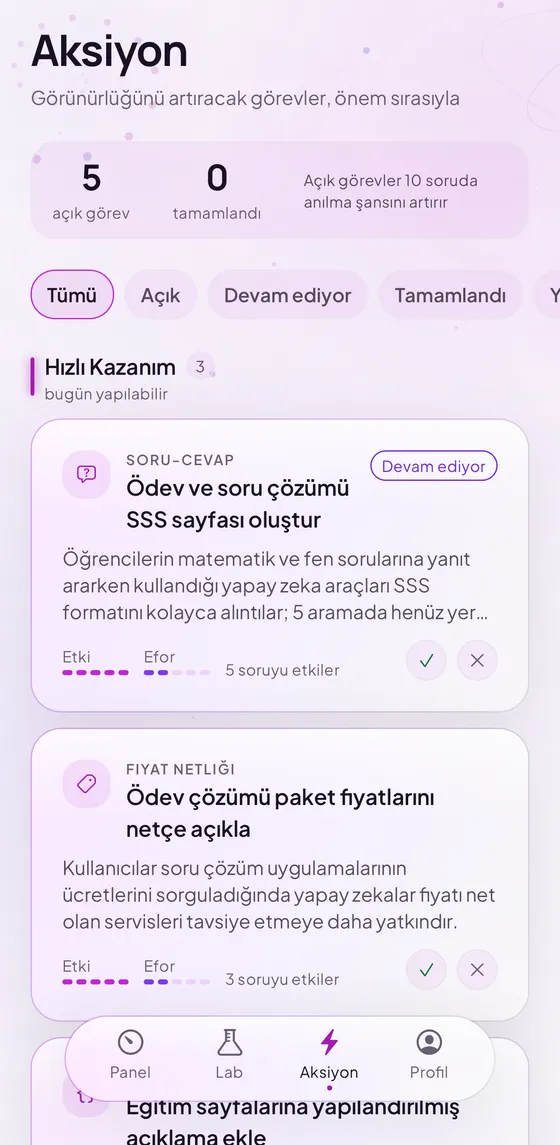
Measurement shows you where you're missing; Action Engine turns that into tasks. Every task is concrete: which page, why, how many questions it affects.
Action types
Grouped under three headings.
Which actions come up depends on your industry, your site's condition and your tracked questions. They don't all come up at once.
Missing page
The site crawl finds which of the page types your industry expects you don't have.
Add an FAQ page
Add an "X vs Y" comparison page
Add a pricing page
Add an about page
Add a use-case page
Add a customer story
Add a glossary
Add a product/service page
Technical access
What the model needs to be able to read your site — tasks that mostly come down to one file.
Allow AI crawlers to access your site
Add an llms.txt file
Add Organization schema
Strengthen the page
For pages that exist but don't get cited: definition box, table, date stamp.
Add citable sections to weak pages
Ranking
How is the list ordered?
High-impact, easy tasks come first; all three inputs to the ranking are visible on the card.
Etki
How much we expect your score to rise once the task is done. It's calculated from how many questions it affects; it's an estimate.
Zorluk
How much effort the task takes. High-impact but easy tasks rise to the top of the list.
Affected questions
Which tracked questions we expect to see answered differently if this task is fixed.
You're in control
“I won't do this job” is an answer too.
You don't have to act on every suggestion a tool makes. Tasks you close aren't lost; they just get out of your way.
Closed
Tasks you're not interested in move to a separate list. The list won't surface them again; if you change your mind, you can reopen them.
Done verification
When you say you've finished a task, the next crawl checks it. If it can't see it, it says “you marked this done, but we couldn't see it in the crawl” — it doesn't silently approve it.
Site crawl
Do you have the pages your industry expects?
Some actions come not from the answers but from the site itself.
The crawl classifies the pages on your site by type: home page, product, pricing, FAQ, blog, about, comparison, use case, customer story, glossary, documentation, contact.
It then looks at which of these types are expected in your industry and turns the gaps into actions. The set of pages expected from a dental clinic isn't the same as the one expected from a SaaS product.
The crawl also checks the technical side: whether AI crawlers can access your site, whether you have an llms.txt file, and whether Organization schema is defined.
FAQ
Frequently asked questions
How reliable is the score gain estimate?
It's an estimate. It's calculated from how many questions the task affects and which component it touches. The real effect only becomes clear when you measure again after the task is done, which is why it's labeled as an estimate.
Can I remove an action I don't want to do?
Yes. You close a task you're not interested in, and the list won't bring it forward again. You can reopen closed tasks from a separate list at any time.
I marked it done but the list still shows it.
When you mark a task as done, we verify it on the next crawl. If the crawl can't see the change, the app says so clearly; the page may not be live yet or may be closed to crawlers.
Where do the actions come from?
From three sources: answers to tracked questions, the site crawl and technical access checks. Each action's card states which finding it came from.

Let's work out together what you need to fix first.
Leave your name, number and company or website; we'll call you within one business day and map out where you stand today together.
- We'll call you within one business day.
- In the call we prepare a proposal tailored to you.
- KVKK compliant; your number is used only for this call.

Not a visibility guarantee — measurable progress.